
A kettlebell workout for beginners over 40 is six moves, learned in order: deadlift, goblet squat, suitcase carry, single-arm row, halo or press, then the two-hand swing. Do two or three rounds of 6 to 12 reps, twice a week, with a bell light enough that your hips do the work, not your back. In a 2022 controlled trial, adults aged 59 to 79 who trained kettlebells three times a week for 12 weeks walked 42 m farther in six minutes. Training was supervised, and injuries ran about 3 per 1,000 training hours, none of them serious.
- Learn the deadlift first and add the two-hand swing only when rep 10 looks like rep 1.
- Set the load move by move, and keep the first two weeks at an easy effort, about 2 to 4 out of 10.
- Two sessions a week matches the federal guideline for muscle-strengthening activity.
- Most kettlebell research uses college-age adults; trials in people over 59 are small but encouraging.
- Expect some early soreness: 71% of those surveyed in a 2022 trial reported it at least once.
Are kettlebells a good idea after 40?
For most adults, yes, provided the bell starts light and someone checks your hinge. One caveat: a 2019 review of 99 kettlebell publications found that 79% of the experiments and trials used healthy college-age participants.
Studies in people over 59 are fewer but encouraging. The 2022 BELL trial enrolled 32 adults aged 59 to 79, 16 men and 16 women, who had not been meeting activity guidelines. They did three supervised group classes a week plus two home sessions for 12 weeks.
Grip strength rose 7.1 kg in the right hand and 6.3 kg in the left. Participants managed 3.3 more sit-to-stands in 30 seconds and added 16.2 kg to their one-rep max deadlift. The program included swings, goblet squats and overhead presses. Two caveats apply: the trial was controlled but not randomized, and its classes held 14 to 16 people.
A 2018 randomized trial of 33 women aged 65 to 75 with sarcopenia, meaning low muscle mass and strength, points the same way. Two kettlebell sessions a week for eight weeks increased their grip strength, back strength and arm and leg muscle mass, and the gains held through four weeks off.
The kettlebell benefits in these trials are practical: grip, deadlift strength, standing up from a chair, walking farther. For maximal strength, though, a barbell may have the edge. A 2012 six-week study of 30 men around age 23 found that weightlifting beat kettlebell training for strength gains, while vertical jump improved about the same in both groups.
Why the hip hinge comes before the swing
The swing loads your low back more than it looks, so it comes last. A 2012 biomechanics study of seven men and one kettlebell master measured about 3,200 newtons of low-back compression during swings with a 16 kg bell. It also reported a backward shear of the L4 vertebra on L5, the opposite of a traditional lift. The authors noted that many people credit swings with better back function, although a few find they irritate tissues.
The 2019 review found no clear risk of harm in trials, but in each reported training injury, a loading error may have been the primary cause. The same review notes that experienced swingers hinge rather than squat: about 20 degrees more hip bend at the bottom and 15 degrees less knee bend on the way down.
Closer to the 40s, a 2011 randomized worksite trial followed 40 adults averaging 44 years old, 85% of them women, in jobs with high rates of musculoskeletal pain. Eight weeks of kettlebell training, three times a week, was associated with lower pain scores than in a control group. On a 0 to 10 scale, the gap was 2.1 points for the neck and shoulders and 1.4 for the low back.
That is one workplace group, not a reason to swing through a sore back. If your back hurts now, talk with your physician or physical therapist first; we're glad to coordinate with them. Our comparison of physical therapists and personal trainers covers who to see after an injury.
The rule we coach by: no swing until your deadlift looks the same on rep 10 as on rep 1. The American Council on Exercise's beginner progression also puts the deadlift before the swing, on the principle that practice makes permanent.
The 6 beginner kettlebell moves, in order
This order builds the hinge first and adds the swing last. For kettlebell exercises over 50, the moves stay the same; the load and depth change.
| Move | What it trains | One cue | What a coach watches for | Easier version |
|---|---|---|---|---|
| Deadlift | Hips, glutes, hamstrings | Hinge at the hips, spine neutral; glutes and backs of the thighs should feel it, not the back | Lower back rounding, or knees bending until it becomes a squat | Lighter bell, or the bell raised on a low block |
| Goblet squat | Legs, hips, trunk | Bell upright at the chest, elbows close to the ribs, back straight | The back losing its straight line at the bottom | Squat only as deep as your back stays straight |
| Suitcase carry | Grip, trunk, posture | Firm grip, back straight, walk 20 to 30 m, then switch hands | Leaning toward the bell | Shorter walk or lighter bell |
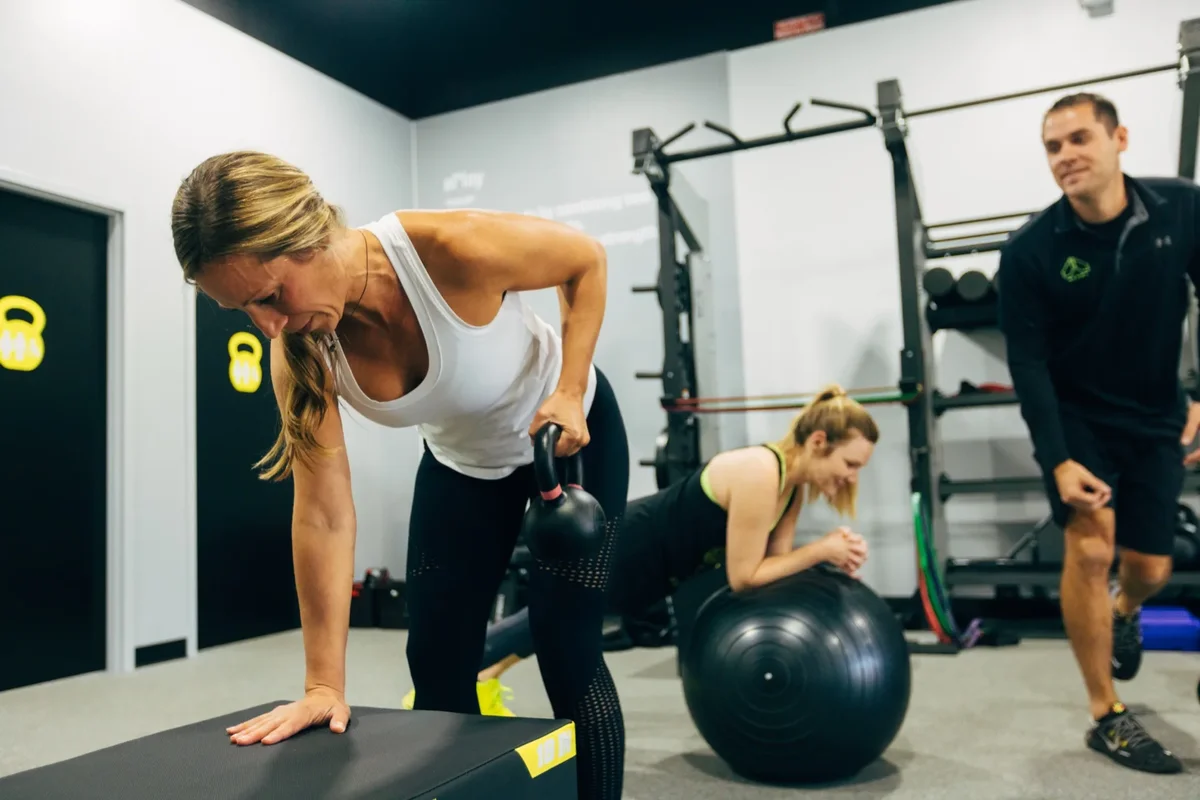
| Single-arm row | Upper back, arms | Knee and hand on a bench; pull until you can't go higher without twisting | The torso rotating to finish the rep | Lighter bell, with a mirror to check for twisting |
| Halo or single-arm press | Shoulders, trunk | Halo: circle the bell around your head, back straight. Press: bell on the forearm, press without locking the elbow, then pull the elbow back down to the ribs | Leaning back to get the bell overhead | The halo with the lightest bell before any press |
| Two-hand swing | Hips, glutes, conditioning | Hinge, swing the bell back between your legs, and let your hips send it to chest height | A squat instead of a hinge, or arms lifting the bell above chest height | Stay with the deadlift until the hinge holds |
If a move hurts, stop and use its easier version; sharp or lingering pain is a question for your physician.
What weight kettlebell should a beginner start with?
A different weight for each move, chosen after someone has watched you hinge. Most online charts give one number for women and another for men, but a bell that suits a deadlift is usually too heavy for a halo or a press.
Use effort instead of a number at first. The BELL trial kept weeks one and two at an effort of 2 to 4 out of 10. From week three, participants worked up to 5 to 7 out of 10. That slow ramp is one way to avoid the loading errors the 2019 review flagged.
In Pinecrest, census figures put roughly three in four adults at 40 or older. Many beginners here are starting over, so the first load should reflect how you move today, not what you lifted years ago. The movement screen in a Personal Fitness Assessment is where those starting loads get set, one move at a time.
A kettlebell workout for beginners you can follow
The circuit itself takes about 20 minutes:
- Warm-up, 5 minutes: easy movement prep for the hips and shoulders.
- Circuit: the six moves in table order, 6 to 12 reps each, with 20 to 30 m per hand on the carry. Leave the swing out until your deadlift passes the rep-10 test.
- Rest: 60 to 90 seconds between rounds.
- Rounds: two to start, three once two feels easy.
- Frequency: two days a week.
Twice a week matches the CDC's guidelines for adults, which call for 2 days of muscle-strengthening activity each week covering all major muscle groups. In a 55-minute coached session, the circuit is one block, with movement prep and mobility work around it.
Add walking on the other days. The same CDC page asks for two and a half hours of moderate-intensity activity a week, and in the 2011 worksite trial, eight weeks of kettlebell training left aerobic fitness unchanged.
South Florida's wet season runs from May 15 to October 15, with almost daily dewpoints in the 70s, so keep the kettlebell work indoors. Evelyn Greer Park next door has a walking and jogging track for the cooler part of the day, and the drier months open up the Old Cutler Trail, shaded walks at Matheson Hammock Park, pickleball at Dante Fascell Park, and a round at Palmetto Golf Course. The hinge and carry strength you build with the bells is what keeps all of them comfortable.
What the first month feels like
Expect some soreness early on. In the BELL trial, 20 of 28 participants (71%) reported some delayed-onset muscle soreness at least once, and 90% said it did not concern them. Supervised attendance still ran at 91.5% over the 12 weeks.
In interviews with 28 of the trial's participants, fear of injury, especially back injury, was a major worry going in. The instructor's coaching and encouragement were a key motivator. As one participant put it: "The fear that people my age have about injury is paramount…we need that extra encouragement."
Most people notice improvements in energy, strength and confidence within the first few weeks. Body-composition change typically shows over 8 to 12 weeks, and long-term results come from consistency. For what else changes as you build up, see our guide to starting strength training after 40.
Why learn the swing with a coach, not a video
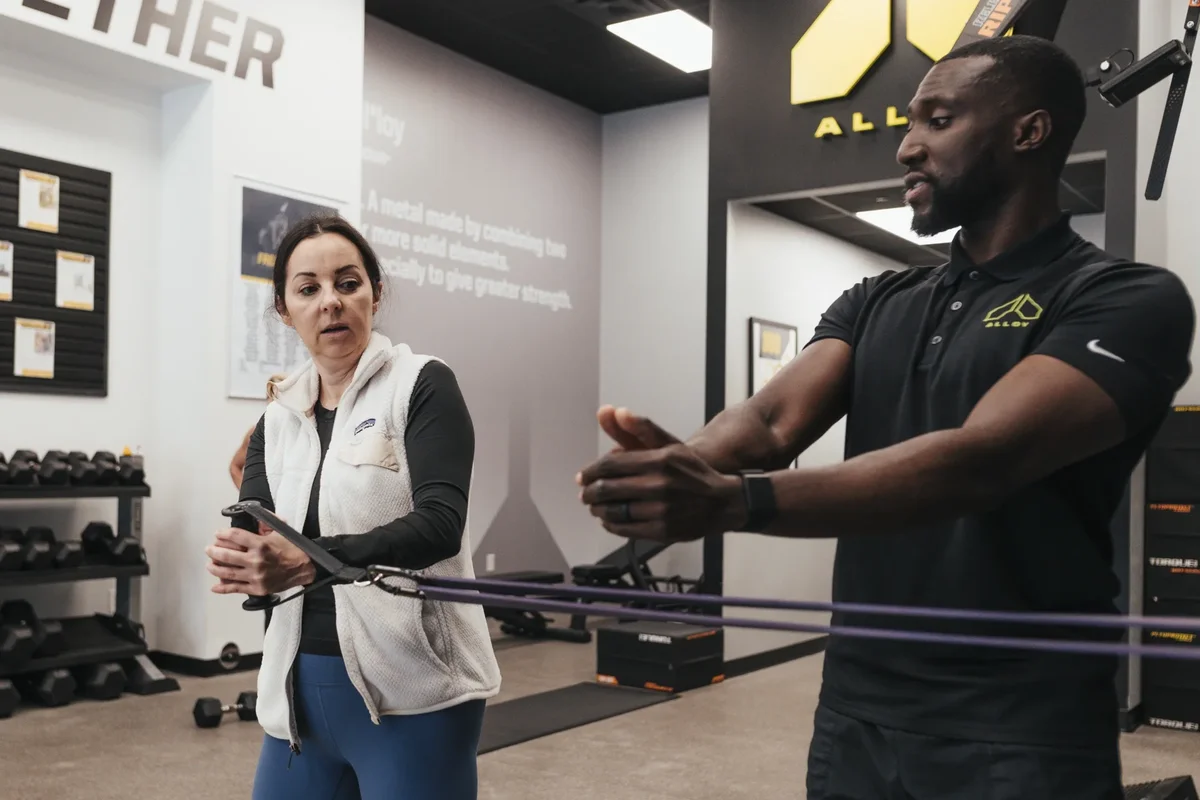
A video can show you a good swing, but it can't see yours. The errors that matter are hard to feel from the inside: a back that starts to round, or knees that bend until the hinge becomes a squat. A coach watching from the side can spot both.
That is the case for small group personal training: six clients per coach at most, less than half the class size in the BELL trial, so every rep gets seen. In Alloy's model, sessions are 55 minutes and coach-led start to finish, and each plan is individualized.
Kettlebells are one tool among several in our strength training for adults over 40. If the swing never suits your back, the deadlift and carries still earn their place.
Start with how you hinge
Your free Personal Fitness Assessment starts before anyone hands you a bell. A coach looks at how you hinge and squat, talks through your health history and goals, measures your fitness baseline and runs your first InBody scan. From there, you get a personalized plan with a starting load for each move and the membership that fits, with no pressure to sign up. Book your free Personal Fitness Assessment.
Opening October 2026 at 8285 SW 124th Street. Our first 75 founding members get first pick of session times, priority onboarding, and our Founder's Rate. See founding membership.
This article is general fitness information, not medical advice. Talk with your physician before starting a new exercise program, especially if you have a diagnosis, a recent injury or surgery, or activity restrictions.